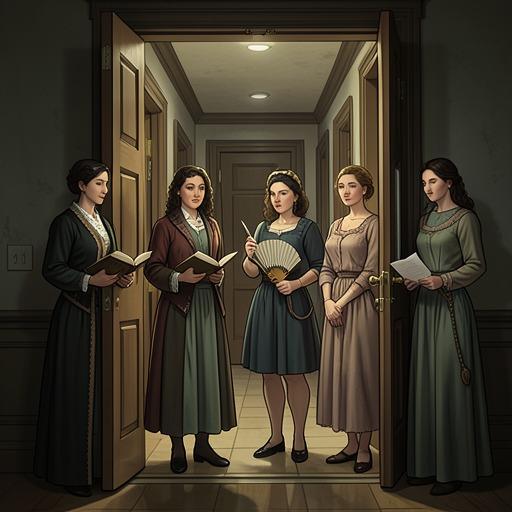
Lydia Bennet
Just DesertsLydia Bennet is the youngest of the Bennet daughters and one of the clearest embodiments of the family’s failure to distinguish affection from responsible care. Spoiled by Mrs. Bennet, encouraged to treat flirtation as a virtue, and left largely unrestrained by Thomas Bennet, she enters society with confidence but without judgment. Her trajectory from the celebrated “lively” girl of Longbourn to a compromised bride and an increasingly distant figure abroad gives the novel one of its sharpest demonstrations of how gender, reputation, family neglect, and military society can turn youthful recklessness into permanent vulnerability.
Identity and Family Position
Lydia is fifteen when the story’s central social crisis begins, and she is the family favorite. Mrs. Bennet calls her lively and attributes her behavior to “animal high spirits,” while Elizabeth Bennet regards the same conduct as ill-mannered. The difference is not merely a disagreement over temperament. Mrs. Bennet repeatedly excuses Lydia and uses maternal approval to make her difficult to correct, whereas Elizabeth sees that the girl is being prepared for a dangerous adulthood without being taught how to manage it.
Lydia’s position within the family is reinforced by the unequal attention given to the sisters. Jane Bennet is treated as the beautiful daughter, Elizabeth as the vexatious one, Kitty Bennet as an easily overlooked follower, and Mary Bennet as the plain, bookish middle child. Lydia, by contrast, resembles Mrs. Bennet in temperament and receives the indulgence that the others do not. Kitty is less than a year and a half older, but Lydia dominates her so thoroughly that the two are commonly imagined as a pair, with Kitty reduced to second fiddle. This arrangement gives Lydia both an audience and a subordinate companion, while depriving Kitty of the confidence to resist her.
The Longbourn entail intensifies the household’s anxiety. Because the estate is entailed away from the female line and Mrs. Bennet can bear no son, the daughters are expected to secure the family’s future through marriage. Mrs. Bennet’s fear that they may be “thrown into the hedgerows” encourages her to push the girls toward society before they possess the maturity to understand its risks. Lydia consequently grows up in a household where marriageability matters more than education, restraint, or moral independence.
Conduct and Social Education
Lydia’s behavior at Netherfield Park displays the public confidence produced by this upbringing. She is introduced into society too early, receives the attention of officers, and develops a strong sense of self-importance from being noticed. During Jane Bennet’s illness, Lydia abruptly reminds Charles Bingley of his promise to hold a ball at Netherfield and declares that failing to keep it would be shameful. Bingley answers courteously, but Lydia’s interruption reveals how little she has learned about tact, occasion, or the distinction between private expectation and public demand.
The same pattern becomes more extreme at the Meryton Assembly. Lydia and Kitty drink, flirt with anyone in a red coat, and Lydia waves an officer’s sword so wildly that she nearly cuts another guest. The incident confirms Fitzwilliam Darcy’s fear that the two youngest Bennet daughters could ruin the family if no one brings them under control. He sees Kitty as a follower, dragged along by Lydia, but regards Lydia as the active source of the disorder. Her behavior is not presented as isolated mischief; it is the result of indulgence, poor parental supervision, and a social environment crowded with soldiers whose attention Mrs. Bennet treats as a compliment.
Elizabeth recognizes the danger before Lydia does. She tells Sir David Pentland that Lydia is only fifteen and that Lieutenant Wickham is almost twice her age. Elizabeth’s greatest fear is not simply that Wickham will exploit her sister, but that Lydia will participate in her own downfall because she has been taught to interpret attention as proof of affection. Lydia accepts Wickham’s polished account of his conflict with Darcy without questioning its contradictions, while Elizabeth detects lies, omissions, and excessive rehearsal. When Elizabeth tries to explain why the story is unreliable, Lydia laughs and assumes that Elizabeth is merely jealous because Wickham prefers Lydia’s company.
The Wickham Crisis and Elopement
Lydia’s attachment to Wickham reveals how her habits make her susceptible to men who understand the uses of charm. Elizabeth proposes introducing Wickham to Edward Gardiner’s legal relative in Meryton and to a clergyman who might assist with his claimed desire to take orders. Wickham becomes visibly alarmed and avoids Elizabeth afterward, behavior that confirms her suspicion that his story cannot withstand scrutiny. Lydia, however, believes him readily and resents anyone who challenges the romance.
Wickham’s death interrupts that danger but does not correct the underlying problem. When the news reaches Longbourn, Lydia’s first response is astonishment that such a handsome man has died, and Mrs. Bennet remains focused on his attractiveness and the attention he had shown Lydia. The family understands that Wickham had made enemies among fathers and brothers seeking vengeance for the women he had harmed, yet Lydia’s emotional response remains fixed on the surface of the relationship. His death removes one predator without removing the habits and social expectations that made Lydia vulnerable to him.
Those habits later produce the more serious crisis. Two days after midsummer, an express arrives at Longbourn reporting that Lydia has attempted to elope with Lieutenant Cyrus Denny. Regular soldiers intercept the pair at the first coaching inn north of Brighton. They have been alone in a hired coach for nearly two hours, and Lydia admits that she has been meeting Denny regularly and believes herself in love. The account identifies the central asymmetry: Lydia imagines an elopement as romantic fulfillment, while Denny’s motives appear base and marriage was not initially part of his plan. Her reputation is therefore compromised, and the family must seek a marriage to prevent her ruin.
The crisis is resolved through pressure from military authority rather than through Lydia’s own judgment. Thomas Bennet and Colonel Foster are summoned to Militia Headquarters, where a Brigadier Anderson and a regular cavalry colonel make clear the seriousness of the situation. Denny subsequently proposes marriage. He purchases a commission in the 41st Regiment of Foot and is ordered to join the regiment in Canada. Thomas Bennet travels to Longbourn, obtains a common licence, and arranges the ceremony on an accelerated timetable.
Marriage, Departure, and Disappearance
The wedding of Lydia Bennet and Cyrus Denny takes place at Longbourn Chapel on Friday, July 3, 1812. Mrs. Bennet must be sedated so that the earlier disorder surrounding the marriage does not become public knowledge, but the ceremony itself is attended by friends and neighbors, followed by a wedding breakfast. Some observers suspect that the speed of the marriage conceals a scandal; the announcement that Denny and Lydia are leaving immediately for Canada prevents most of the speculation from spreading.
On Monday, July 6, Lydia leaves Longbourn after saying farewell. It is the last time any member of her family sees her in person. Letters arrive only infrequently, and each contains a demand for money. Apart from Mrs. Bennet, the family sends no additional funds, forcing Lydia to confront the economic reality of marriage to a junior officer. Her new life consists of low pay, heavy deductions, little entertainment, and meagre rations, in stark contrast to the warmth, plentiful food, and modest allowance she had enjoyed at Longbourn.
Lydia does not interpret her hardship as the consequence of her own choices. She blames her family for failing to support her generously and remains unchanged in her sense of entitlement. After the war with the Americans, the 41st Regiment is assigned to India. Lydia and her family lose contact when the regiment reaches that destination. She has at least two children who survive infancy, but Lydia Denny and her family eventually disappear from the family’s knowledge.
Relationships and Narrative Significance
Lydia’s strongest early attachment is to Mrs. Bennet, whose approval supplies the authority that Thomas Bennet withholds and Elizabeth Bennet cannot exercise. Mrs. Bennet praises Lydia’s liveliness, encourages her to flirt with men, and treats the attention of officers as evidence of success. Elizabeth, by contrast, attempts to parent Lydia and Kitty without possessing either the parental authority or consistent support required to make the effort effective. Mrs. Bennet’s constant contradiction of Elizabeth’s explanations ensures that Lydia hears correction as interference rather than care.
Lydia’s relationship with Kitty illustrates the social reproduction of unequal power among the sisters. Lydia does not need to persuade Kitty through argument; she assumes Kitty’s compliance, and Kitty follows. Only after Lydia becomes absorbed in the company of the young wife of a militia colonel does Kitty begin to resist. Excluded from Lydia’s whispered conversations and laughter, Kitty spends more time with Jane and Mary Bennet, joins them on tenant visits, and gradually learns the practical realities of a junior officer’s wife. The change belongs primarily to Kitty, but it also clarifies Lydia’s influence: Lydia’s power over her sister rests on habit and attention rather than genuine mutuality.
Elizabeth’s attitude toward Lydia becomes increasingly severe because she sees both the structural dangers around her and Lydia’s refusal to recognize them. After Lydia’s marriage, Elizabeth refuses to exclude her from the family’s future entirely, but she also refuses to pretend that Lydia’s conduct was harmless. When the Gardiners ask about the provision for Lydia, Elizabeth insists that Lydia is now the respectable wife of a regular infantry officer, but she adds that no one wishes to say what Lydia might have become or would probably have become without that marriage. Elizabeth expects Mrs. Bennet to give Lydia the whole of her dowry and accepts that arrangement without expressing regret for the unequal distribution.
Lydia’s later absence becomes a measure of the consequences she has never acknowledged. Jane Bennet, described as the most forgiving sister and the one most likely to maintain contact, has not heard from Lydia in a decade after Denny’s regiment goes to India. Even in the family’s later reflections, Lydia remains less a reconciled relative than a warning about actions whose effects cannot be undone by sentiment. Her disappearance does not provide a redemptive transformation; it completes the pattern established at Longbourn, where indulgence is mistaken for love, attention for security, and marriage for rescue.